Weather Alert in Montana
Winter Storm Warning issued March 11 at 9:21AM MDT until March 14 at 12:00PM MDT by NWS Missoula MT
AREAS AFFECTED: West Glacier Region
DESCRIPTION: * WHAT...For the Winter Weather Advisory, snow. Additional snow accumulations up to 4 inches. For the first Winter Storm Warning, heavy snow expected. Total snow accumulations up to 6 inches. For the Blizzard Warning, blizzard conditions expected. There is a high likelihood of extreme impacts from strong winds and falling and/or blowing snow on US Highway 2 east of West Glacier to Marias Pass and in backcountry and mountain areas. Wind gusts up to 80 mph. For the second Winter Storm Warning, heavy snow expected. There is a likelihood of major winter weather impacts winter storm impacts. Total snow accumulations between 5 and 20 inches. Winds gusting as high as 40 mph. * WHERE...Polebridge, Marias Pass, Bad Rock Canyon, Highway 83 Bigfork to Swan Lake, Glacier National Park, and Essex. * WHEN...For the Winter Weather Advisory, until 6 PM MDT this evening. For the first Winter Storm Warning, from 6 PM this evening to midnight MDT tonight. For the Blizzard Warning, from midnight tonight to 9 AM MDT Thursday. For the second Winter Storm Warning, from 9 AM Thursday to noon MDT Saturday. * IMPACTS...Whiteout conditions are expected and will make travel treacherous and potentially life-threatening late Wednesday night through Thursday morning. For EXTREME winter storm impacts, expect substantial disruptions to normal activities. Extremely dangerous or impossible traveling conditions. Travel in the impacted areas is not advised. Extensive and widespread closures and disruptions to infrastructure may occur. Life saving actions may be needed. Very strong winds could cause extensive tree damage. Visibilities may drop below 1/4 mile due to falling and blowing snow. * ADDITIONAL DETAILS...High winds will impact all elevations late tonight through Thursday morning with wind gusts of 60 to 80 mph.
INSTRUCTION: Persons should consider delaying all travel. If travel is absolutely necessary, drive with extreme caution. Consider taking a winter storm kit along with you, including such items as tire chains, booster cables, flashlight, shovel, blankets and extra clothing. Also take water, a first aid kit, and anything else that would help you survive in case you become stranded. A Blizzard Warning means severe winter weather conditions are expected or occurring. Falling and blowing snow with strong winds are likely. This will lead to whiteout conditions, making travel extremely dangerous. Do not travel. If you must travel, have a winter survival kit with you. If you get stranded, stay in your vehicle.
Want more detail? Get the Complete 7 Day and Night Detailed Forecast!
Current U.S. National Radar--Current
The Current National Weather Radar is shown below with a UTC Time (subtract 5 hours from UTC to get Eastern Time).

National Weather Forecast--Current
The Current National Weather Forecast and National Weather Map are shown below.

National Weather Forecast for Tomorrow
Tomorrow National Weather Forecast and Tomorrow National Weather Map are show below.

North America Water Vapor (Moisture)
This map shows recent moisture content over North America. Bright and colored areas show high moisture (ie, clouds); brown indicates very little moisture present; black indicates no moisture.

Weather Topic: What are Stratus Clouds?
Home - Education - Cloud Types - Stratus Clouds
 Next Topic: Wall Clouds
Stratus clouds are similar to altostratus clouds, but form at a
lower altitude and are identified by their fog-like appearance, lacking the
distinguishing features of most clouds.
Stratus clouds are wider than most clouds, and their base has a smooth, uniform
look which is lighter in color than a nimbostratus cloud.
The presence of a stratus cloud indicates the possibility of minor precipitation,
such as drizzle, but heavier precipitation does not typically arrive in the form
of a stratus cloud.
Next Topic: Wall Clouds
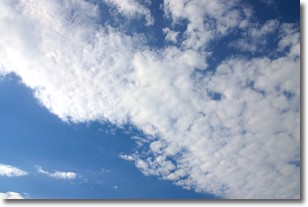
Weather Topic: What are Altocumulus Clouds?
Home - Education - Cloud Types - Altocumulus Clouds
 Next Topic: Altostratus Clouds
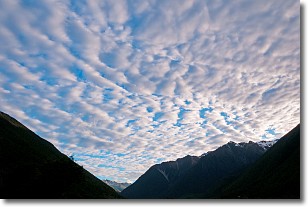
Similar to cirrocumulus clouds, altocumulus clouds are
characterized by cloud patches. They are distinguished by larger cloudlets
than cirrocumulus clouds but are still smaller than stratocumulus clouds.
Altocumulus clouds most commonly form in middle altitudes (between 2 and 5 km)
and may resemble, at times, the shape of a flying saucer.
These uncommon formations, called altocumulus lenticularis, are created by uplift
in the atmosphere and are most often seen in close proximity to mountains.
Next Topic: Altostratus Clouds
Current conditions powered by WeatherAPI.com