Weather Alert in Montana
Winter Storm Watch issued March 11 at 2:15PM MDT until March 15 at 6:00AM MDT by NWS Billings MT
AREAS AFFECTED: Musselshell; Treasure; Northern Stillwater; Powder River; Golden Valley; Northern Big Horn; Southern Rosebud; Judith Gap; Southern Big Horn; Northern Sweet Grass; Melville Foothills; Northeastern Yellowstone; Southern Wheatland; Southwestern Yellowstone; Sheridan Foothills
DESCRIPTION: * WHAT...Heavy snow possible. Total snow accumulations between 7 and 14 inches possible. Winds could gust as high as 30 mph. * WHERE...Portions of central, south central, and southeast Montana and north central Wyoming. * WHEN...From Thursday evening through late Saturday night. * IMPACTS...Roads, and especially bridges and overpasses, will likely become slick and hazardous. Travel could be very difficult to impossible. The hazardous conditions could impact the Thursday evening and Friday morning commutes. Conditions may threaten young livestock. * ADDITIONAL DETAILS...Accumulating snowfall is expected to develop Thursday night and continue through Saturday night. The heaviest snowfall potential is currently across areas mainly north of I-90 and I-94 in the Watch area, but placement of heaviest snow may change. Please check the latest forecasts.
INSTRUCTION: People should delay all travel if possible. If travel is absolutely necessary, drive with extreme caution and be prepared for sudden changes in visibility. Leave plenty of room between you and the motorist ahead of you, and allow extra time to reach your destination. Avoid sudden braking or acceleration, and be especially cautious on hills or when making turns. Make sure your car is winterized and in good working order.
Want more detail? Get the Complete 7 Day and Night Detailed Forecast!
Current U.S. National Radar--Current
The Current National Weather Radar is shown below with a UTC Time (subtract 5 hours from UTC to get Eastern Time).

National Weather Forecast--Current
The Current National Weather Forecast and National Weather Map are shown below.

National Weather Forecast for Tomorrow
Tomorrow National Weather Forecast and Tomorrow National Weather Map are show below.

North America Water Vapor (Moisture)
This map shows recent moisture content over North America. Bright and colored areas show high moisture (ie, clouds); brown indicates very little moisture present; black indicates no moisture.

Weather Topic: What is Rain?
Home - Education - Precipitation - Rain
 Next Topic: Shelf Clouds
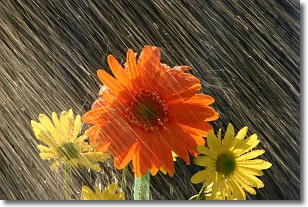
Precipitation in the form of water droplets is called rain.
Rain generally has a tendency to fall with less intensity over a greater period
of time, and when rainfall is more severe it is usually less sustained.
Rain is the most common form of precipitation and happens with greater frequency
depending on the season and regional influences. Cities have been shown to have
an observable effect on rainfall, due to an effect called the urban heat island.
Compared to upwind, monthly rainfall between twenty and forty miles downwind of
cities is 30% greater.
Next Topic: Shelf Clouds
Weather Topic: What is Sleet?
Home - Education - Precipitation - Sleet
 Next Topic: Snow
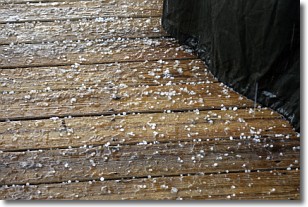
Sleet is a form of precipitation in which small ice pellets are the primary
components. These ice pellets are smaller and more translucent than hailstones,
and harder than graupel. Sleet is caused by specific atmospheric conditions and
therefore typically doesn't last for extended periods of time.
The condition which leads to sleet formation requires a warmer body of air to be
wedged in between two sub-freezing bodies of air. When snow falls through a warmer
layer of air it melts, and as it falls through the next sub-freezing body of air
it freezes again, forming ice pellets known as sleet. In some cases, water
droplets don't have time to freeze before reaching the surface and the result is
freezing rain.
Next Topic: Snow
Current conditions powered by WeatherAPI.com